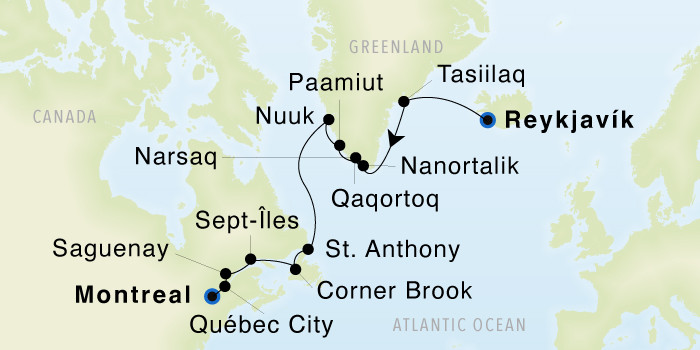
Reykjavik, Iceland's geothermal capital, opens the voyage beneath Hallgrimskirkja's spire and the glass-clad Harpa hall rising above a harbor built for Viking descendants, before a course north into the Arctic. In Tasiilaq, painted timber houses climb beneath Flower Valley as Sermilik Fjord calves icebergs offshore, then thread Prince Christian Sound, a corridor of granite walls and hanging glaciers where waterfalls tumble past the hamlet of Aappilattoq. Granite spired Nanortalik and green Narsaq, overlooked by Erik the Red's Brattahlid, lead to Qaqortoq, its ochre and blue houses tumbling toward the only fountain in Greenland and the rock cut Stone and Man sculptures, a UNESCO listed landscape. Continue to Nuuk, Greenland's capital, where the National Museum's Qilakitsoq mummies meet a fjord system among the world's grandest. Cross to Newfoundland's St. Anthony, gateway to the Norse landfall at L'Anse aux Meadows, then Corner Brook, its UNESCO listed Gros Morne tablelands rising from the Bay of Islands. Glide the dark waters of the Saguenay Fjord before Quebec City's UNESCO ramparts and Old Town welcome you ashore. Your voyage concludes in Montreal, where cobbled Vieux Montreal and the soaring Notre-Dame Basilica close this journey across two worlds joined by ice and stone.
Date
Ports of Call
Arrive
Depart
Aug 03, 2030
Reykjavík, Iceland
2 PM - 4 PM
(Embarkation)
Evening
The world's northernmost capital pairs Nordic design with a landscape that starts changing the moment you leave town. Climb the tower of Hallgrimskirkja for a view over rooftops the color of a paint chart, browse the harbor's design shops and the Harpa concert hall's glass facade, then head out on the Golden Circle to the rift valley at Thingvellir, the eruptive Geysir and the thundering Gullfoss falls. Back in town, a New Nordic tasting menu of Arctic char and skyr caps a day that can just as easily end in a geothermal soak. Small, cool and endlessly photogenic.
East Greenland's largest settlement is also its wildest, a huddle of timber houses on Ammassalik Island facing a coastline of jagged peaks and pack ice that keeps this side of the country cut off from the world for much of the year. The Tunumiit people here kept a language and a culture distinct from West Greenland well into the twentieth century, still visible in the small museum's carved masks and drum-dance traditions. Icebergs run aground in the bay by the hundred, calved from one of the fastest-moving glaciers on earth. Remote even by Greenlandic standards.
A narrow, glacier-carved channel cuts through the southern tip of Greenland, granite walls rising sheer on both sides in a passage so tight in places that the ship's wake reaches both shores at once. Icebergs calved from glaciers further up the fjord drift through on the current, and the surrounding peaks hold some of South Greenland's most dramatic scenery. A spectacular shortcut around Greenland's southernmost cape.
Greenland's southernmost town takes its name, fittingly, from the Inuktitut for "place of polar bears". Turf-roofed buildings from the old colonial trading post now form an open-air museum on the harborfront, backed by the vertical granite spires of Ketil and Ulamertorsuaq that draw climbers from across the world. Icebergs calved from nearby glaciers drift past the anchorage in slow procession, and Norse ruins from the medieval Eastern Settlement lie scattered across the surrounding fjords. A raw, dramatic first taste of South Greenland.
The largest town in South Greenland gathers around Greenland's oldest fountain, its square ringed by a remarkable open-air gallery, more than forty sculptures carved directly into the surrounding rock faces by artists from across the Nordic world. A short boat ride away, the natural hot springs of Uunartoq Island let you soak in geothermal warmth with icebergs drifting past in the fjord beyond, while the ruined stone walls of Hvalsey Church, the best-preserved Norse building in Greenland and the site of the last written record of its medieval settlers, stand a few miles further on. History, art and a hot spring, in one small harbor.
Ringed by icebergs calved from the Eqalorutsit glacier, Narsaq sits at the gateway to Greenland's Norse country, the ruins of Erik the Red's own farmstead lie a short sail away across the fjord. Sheep farms carved from the same slopes the Vikings grazed still supply the country's wool and lamb, and the town's small brewery, among the world's most northerly, turns out a beer brewed with local glacial water. A geologist's paradise too, the surrounding hills hold some of the rarest mineral deposits on the planet. Understated, but rich in both history and ice.
A scatter of brightly painted wooden houses on a rocky headland, Paamiut is one of Greenland's smallest and least-visited towns, and precisely for that reason one of its most genuine. White-tailed eagles nest along the surrounding cliffs, among the best birdwatching on this coast, while the old colonial buildings and a working fishing harbor show a Greenland unshaped by tourism. Few ships of any size call here. That, more than anything, is the point.
Greenland's small, colorful capital packs Inuit culture and Arctic modernity into a single fjord-side afternoon. Browse the National Museum's mummies and kayaks, then cross to the Katuaq cultural center for contemporary Greenlandic art, before a plate of musk ox or snow crab at one of the country's few fine-dining tables. A round at Nuuk Golf Club, the world's northernmost, plays out beneath jagged peaks and the midnight sun, while a whale-watching run into Nuup Kangerlua fjord is as likely to turn up humpbacks as icebergs. The Arctic's most livable secret.
The unofficial capital of Iceberg Alley, where Arctic ice drifting down from Greenland runs aground each spring in scenes that draw photographers from around the world. Sir Wilfred Grenfell's pioneering medical mission, which brought healthcare to this remote coast in the early 1900s, is remembered at a museum and historic house in town, while L'Anse aux Meadows, the only confirmed Norse settlement in North America, lies a scenic drive up the coast. A hearty Newfoundland kitchen, heavy on cod and partridgeberry, rounds out one of the province's most remote and dramatic corners.
Newfoundland's second city sits on the Bay of Islands, a fjord-cut stretch of coast that Captain James Cook himself surveyed and mapped in the 1760s, well before his Pacific voyages made him famous. Marble Mountain rises straight from the water behind town, its slopes better known today for skiing than for the marble that gave it its name. Golf courses take advantage of some of the most dramatic scenery on the island's west coast. A rugged, unpolished introduction to Newfoundland.
A North Shore port town named for the seven islands that shelter its harbor, home to a scattered Innu community whose culture and history are shown at the town's small but excellent regional museum. The surrounding archipelago's cliffs and islets hold significant seabird colonies, guillemots and eiders among them, largely undisturbed by the iron-ore shipping that built the modern town. A working port with a genuinely wild edge.
Where the Saguenay Fjord, one of the longest in the world outside the Arctic, meets the St Lawrence, cold, nutrient-rich water wells up to create one of the richest whale feeding grounds in eastern Canada, belugas resident year-round, minke and even blue whales through the summer. The town's own dining scene draws on the region's wild blueberries and its distinctive tomme cheese, both genuine points of local pride. Fjord walls rise nearly a thousand feet on either side of the water, some of the most dramatic scenery east of the Rockies.
The only walled city north of Mexico still standing in its entirety, Quebec City's Chateau Frontenac towers over a UNESCO old town of cobbled lanes and 17th-century stone houses that could pass, at a glance, for provincial France. Ile d'Orleans, a short drive across the bridge, supplies much of the region's cider, maple and cool-climate wine, while the city's own Nordic-style spas, built around riverside steam and plunge pools, draw on a wellness tradition as old as New France itself. A beach along the St Lawrence and a genuinely serious dining scene round out North America's most European city.
The only walled city north of Mexico still standing in its entirety, Quebec City's Chateau Frontenac towers over a UNESCO old town of cobbled lanes and 17th-century stone houses that could pass, at a glance, for provincial France. Ile d'Orleans, a short drive across the bridge, supplies much of the region's cider, maple and cool-climate wine, while the city's own Nordic-style spas, built around riverside steam and plunge pools, draw on a wellness tradition as old as New France itself. A beach along the St Lawrence and a genuinely serious dining scene round out North America's most European city.
North America's great bilingual city layers cobbled Old Montreal, its 17th-century stone buildings now home to some of the country's best restaurants, over a modern downtown built for a genuinely serious food and festival culture. The Lachine Canal's bike path and waterfront parks offer an easy afternoon on the water, while the Eastern Townships' vineyards, a short drive out, have quietly become a real source of Quebec ice wine and hybrid varietals. A round of golf on one of the island's historic courses and a stroll through a beach-lined riverfront park round out a city that rewards a slow wander as much as a fine meal.
Fares are per person based on double occupancy and include government, port and service fees. Fares are capacity controlled and may change without notice.
Yachting Land Adventures & Activities
We are curating extraordinary, bucket-list experiences across the globe for SeaDream III. Details of these once-in-a-lifetime Yachting Land Adventures will be unveiled in the months ahead.
Testimonials
We really had a great time which far exceeded our expectations.
Mr & Mrs AmbroseTexas
We have done other small ships in the past, but you guys take it to a higher level. We were very happy with everything, Ship, Captain, Crew, Cuisine, just outstanding and made us feel like family!
Mr. & Mrs. HartNew Mexico