Active: Hammerfest, Kirkenes, Honningsvåg (North Cape), Barentsburg, Svalbard, Sailing through Adolfbukta, Sailing through Nordre Isfjorden National Park, Sailing through Forlandet National Park, LongyearbyenBird Watching: Kirkenes, Honningsvåg (North Cape), Sailing past Bear Island, Pyramiden, Svalbard, Sailing through Nordre Isfjorden National Park, Sailing through Forlandet National Park, Ny-Ålesund, Sailing through Kongsfjorden, Sailing through Magdalenefjord, Sailing past Alkhornet, LongyearbyenDining: Kirkenes, Honningsvåg (North Cape), Barentsburg, Svalbard, Longyearbyen
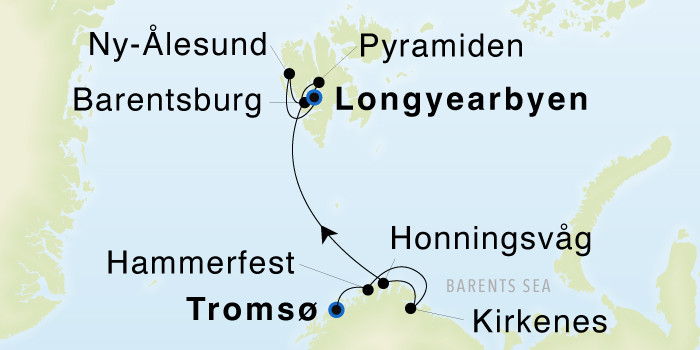
Embark from Tromsø for Hammerfest, one of the world's northernmost towns and home to the Royal and Ancient Polar Bear Society, then continue to Kirkenes on Norway's Russian frontier and Honningsvåg, gateway to Nordkapp's wind-scoured plateau at 71 degrees north. Sail past the seabird cliffs of Bear Island toward Svalbard, where Barentsburg's Lenin bust and northernmost brewery recall a Soviet outpost, and Pyramiden's abandoned streets stand silent beneath the Nordenskiöld glacier. Cruise the calving face of Adolfbukta and the protected wilds of Nordre Isfjorden and Forlandet, watching for walrus and Arctic fox, before Ny-Ålesund, the world's northernmost year-round settlement, where Amundsen's airship mast still stands. Kittiwakes swirl beneath the peaks of Kongsfjorden, and Magdalenefjord's glaciers calve beside centuries-old whalers' graves. Past the guillemot cliffs of Alkhornet, ending in Longyearbyen, the world's northernmost true town, where polar bears roam beyond the last street lamp under endless summer light.
Date
Ports of Call
Arrive
Depart
Jul 14, 2030
Tromsø, Norway
2 PM - 4 PM
(Embarkation)
Evening
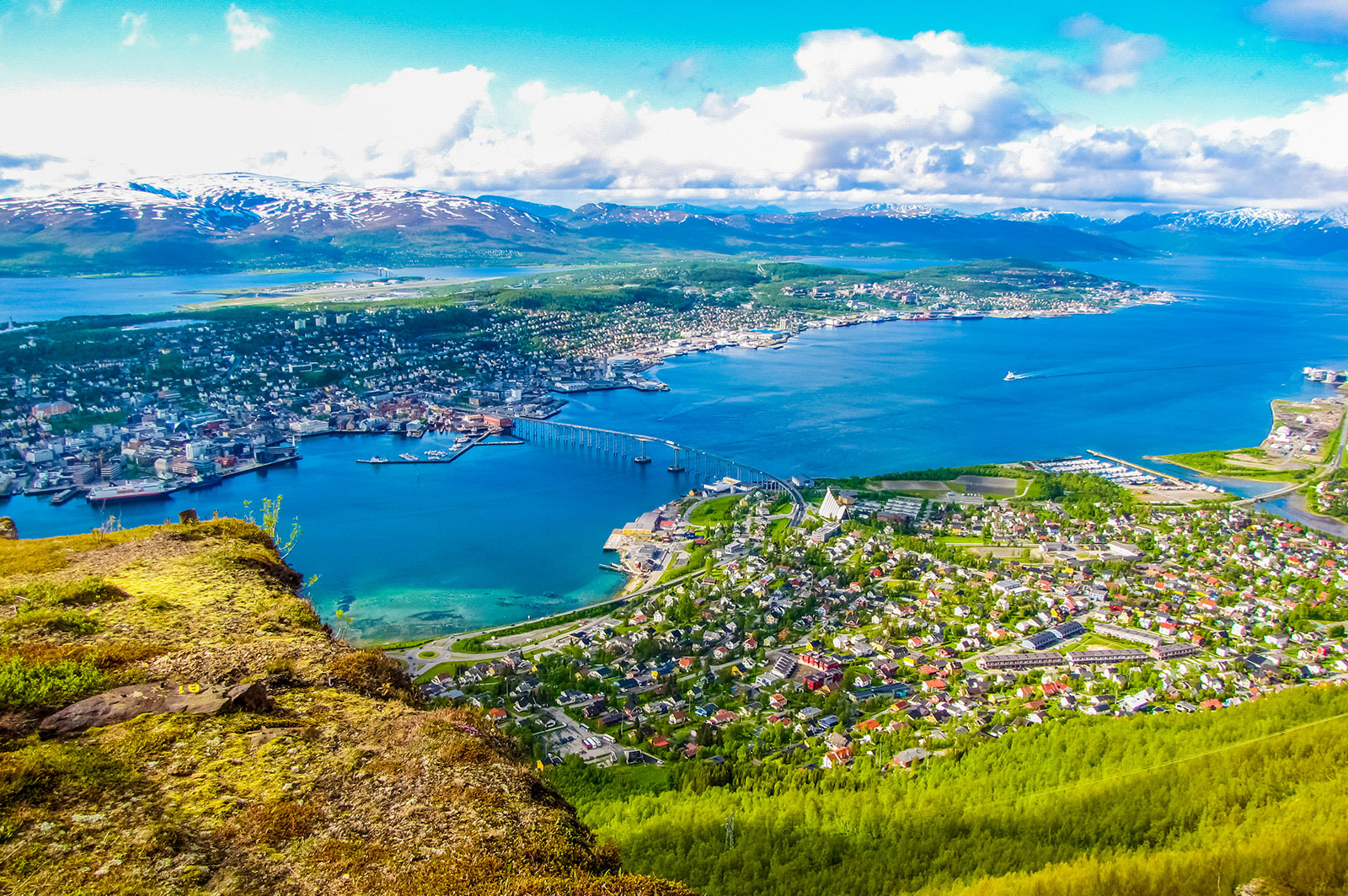
If you’re seeking a northern Eden, it doesn’t get much closer than Tromsø, an unhurried city cradled by spectacular fjords and titanic mountains. Among nature’s most magnificent displays, marvel at the nightless days of the midnight sun. Wind along the glasslike waters of the Balsfjorden, Kaldfjorden, Ullsfjorden and Malangen fjords, watching achingly beautiful panoramas unfold as you keep a sharp eye out for seals, eagles and reindeer.
In Tromsø, delight in the angular forms of the Arctic Cathedral, which evokes a steep, snow-coated mountain or slabs of ice jutting into the sky. A short distance away, ride a cable car to nearly 1,400 feet above sea level for sweeping views of the town and the intense blues, greens and whites of the surrounding scenery. Examine a unique array of cold-climate plants at the Arctic-Alpine Botanical Garden, which showcases specimens from far-flung lands such as Tibet, and unwind with a cold one at celebrated Macks Ølbryggeri, a local institution that is proud to be “the world’s northernmost brewery.”
One of the northernmost towns on earth wears that title with pride, burned to the ground by retreating German forces in 1944 and rebuilt from nothing since. The Royal and Ancient Polar Bear Society keeps the town's Arctic hunting history alive in a small, characterful museum, while the midnight sun keeps the harbor lit through the small hours of a summer night. A working town at the edge of the map, more than a tourist set-piece.
In Norway's far northeast, Kirkenes built its fortunes on iron ore and, more recently, on the king crab that now draws visitors out onto the Barents Sea on dedicated safaris. The town absorbed more Allied bombing than almost anywhere else in Norway during the Second World War and was liberated by Soviet troops in 1944, a history the local war museum tells unflinchingly. Husky kennels and a Snow Hotel built fresh each winter round out a town shaped as much by its remoteness as by its history. A genuine frontier post.
The gateway to the North Cape, the dramatic thousand-foot cliff plateau long billed as continental Europe's northernmost point, sits just a short drive from this small fishing town's harbor. Stand at the globe monument as the midnight sun refuses to set, or scan the surrounding cliffs for the kittiwakes and puffins that nest by the thousand along this stretch of coast. A short evening's sail from the town's own restaurants, where reindeer and king crab share the menu. As far north as most travelers will ever stand on solid ground.
The loneliest island in the Svalbard archipelago rises from the Barents Sea roughly halfway between mainland Norway and Spitsbergen, its cliffs holding one of the largest seabird colonies in the North Atlantic, several hundred thousand guillemots, kittiwakes and puffins nesting on ledges too sheer for almost anything else to reach. Wrecks litter the surrounding seabed, testament to weather that can turn in minutes this far into open water. A handful of Norwegian meteorologists are the island's only residents. About as remote a headland as this itinerary passes.
A working Russian coal town deep inside Norwegian territory, Barentsburg still houses a small community of Russian and Ukrainian miners beneath the world's northernmost bust of Lenin. The Pomor Museum traces centuries of Russian Arctic history, and the settlement's brewery, also the world's northernmost, pours a beer brewed on melted glacier water. A living piece of Soviet-era geopolitics, still functioning in the High Arctic.
A Soviet coal town abandoned wholesale in 1998, Pyramiden stands frozen at the moment its last residents left, a bust of Lenin gazing out over empty apartment blocks, a grand piano still in the culture hall, the world's northernmost swimming pool now drained and silent. Kittiwakes nest in their thousands in the cliffs behind the settlement, and a glacier calves into the fjord within full view of the crumbling waterfront. One of the strangest, most haunting stops in the entire Arctic.
A quiet bay deep inside Billefjorden delivers a full frontal view of Nordenskioldbreen, one of Svalbard's great tidewater glaciers, its blue-white face calving directly into the fjord in front of the ship. The surrounding shoreline holds the remains of early 20th-century coal-mining ventures, abandoned almost as soon as they began, a reminder of how unforgiving this coast has always been. A hushed, ice-fringed anchorage deep in the Arctic interior.
Sailing through Nordre Isfjorden National Park, Norway
Morning
Afternoon
Svalbard's largest system of protected fjords and glaciers unfolds along this stretch, tundra slopes grazed by reindeer running down to water regularly visited by beluga whales and bearded seals. Arctic terns and glaucous gulls wheel over cliffs that see barely any human presence beyond the odd research station. The park protects some of the most complete and undisturbed high-Arctic ecosystems left on the planet, glacier to shoreline to sea.
A narrow strip of national park protects Prins Karls Forland, a mountainous island running parallel to Spitsbergen's west coast, its beaches at Poolepynten home to one of Svalbard's most reliable walrus haul-outs, dozens of the tusked giants often visible hauled out together on the gravel. Glaciers spill from the island's interior peaks directly to the shore. A quiet, wildlife-rich sail along one of Svalbard's least-visited coastlines.
The northernmost permanent settlement on the planet is not a town so much as an international research station, its handful of year-round residents drawn from Norway, Germany, France, China, Japan, Korea, India and beyond. The mast Roald Amundsen used to launch the airship Norge on the first verified flight over the North Pole in 1926 still stands at the edge of the old mining settlement it replaced. Arctic terns dive-bomb visitors who stray too near their nests along the boardwalk. About as far from anywhere as a port call gets.
This broad, glacier-rimmed fjord shares its shores with Ny-Alesund, the world's northernmost permanent settlement, and its waters have made it one of the most studied stretches of coastline in the Arctic. Kongsbreen and Kronebreen, two of Svalbard's most active tidewater glaciers, calve into the fjord in full view of passing ships, while kittiwakes and Arctic terns work the cliffs above. A working laboratory for High Arctic science, and a genuinely spectacular one to sail through.
Dutch and English whalers first anchored in this sheltered bay in the early 1600s, rendering blubber at the shore station of Smeerenburg nearby in numbers that briefly made it one of the busiest, and most brutal, industrial operations anywhere in the Arctic. Wooden grave markers at Gravneset still hold the remains of whalers who never made it home. Glaciers now calve quietly into water that was once slicked with oil, one of Svalbard's most historically loaded, and most beautiful, anchorages.
A distinctive horned mountain marks the entrance to Isfjorden, its lower slopes improbably green for the Arctic thanks to a bird cliff above that fertilises the tundra below, drawing reindeer and Arctic fox to graze where almost nothing else grows this far north. Thousands of Brunnich's guillemots and kittiwakes nest on the ledges overhead. A single mountain that concentrates an entire Arctic food chain into one dramatic headland.
The world's northernmost town with a supermarket, a church and a pub still requires a rifle if you leave the settlement on foot, polar bears roam freely across Svalbard's tundra. Its permafrost is so complete that burial is not permitted, one of the more startling facts you'll pick up at the excellent Svalbard Museum, while the Global Seed Vault sits carved into a mountainside just outside town, a doomsday backup for the world's crops. Former mining infrastructure still threads the hillsides above a settlement now built as much around Arctic research as coal. As far north as ordinary life gets.
Fares are per person based on double occupancy and include government, port and service fees. Fares are capacity controlled and may change without notice.
Yachting Land Adventures & Activities
We are curating extraordinary, bucket-list experiences across the globe for SeaDream III. Details of these once-in-a-lifetime Yachting Land Adventures will be unveiled in the months ahead.
Testimonials
The best vacation we have ever been on. The combination of relaxed atmosphere and impeccable service was perfect.
Mr & Mrs PedersonConnecticut
The chef is outstanding. Every dish was excellent – loved the Indian menu.
Mr. & Mrs. HardyTennessee