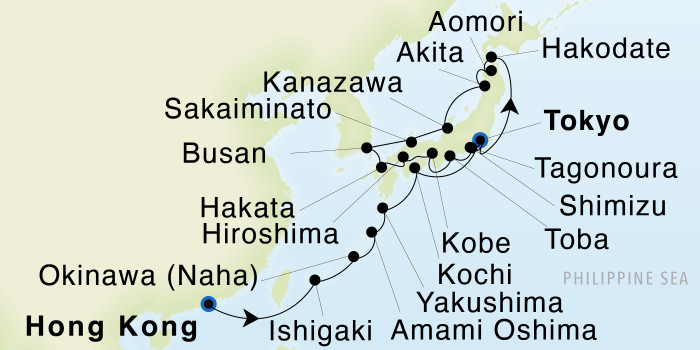
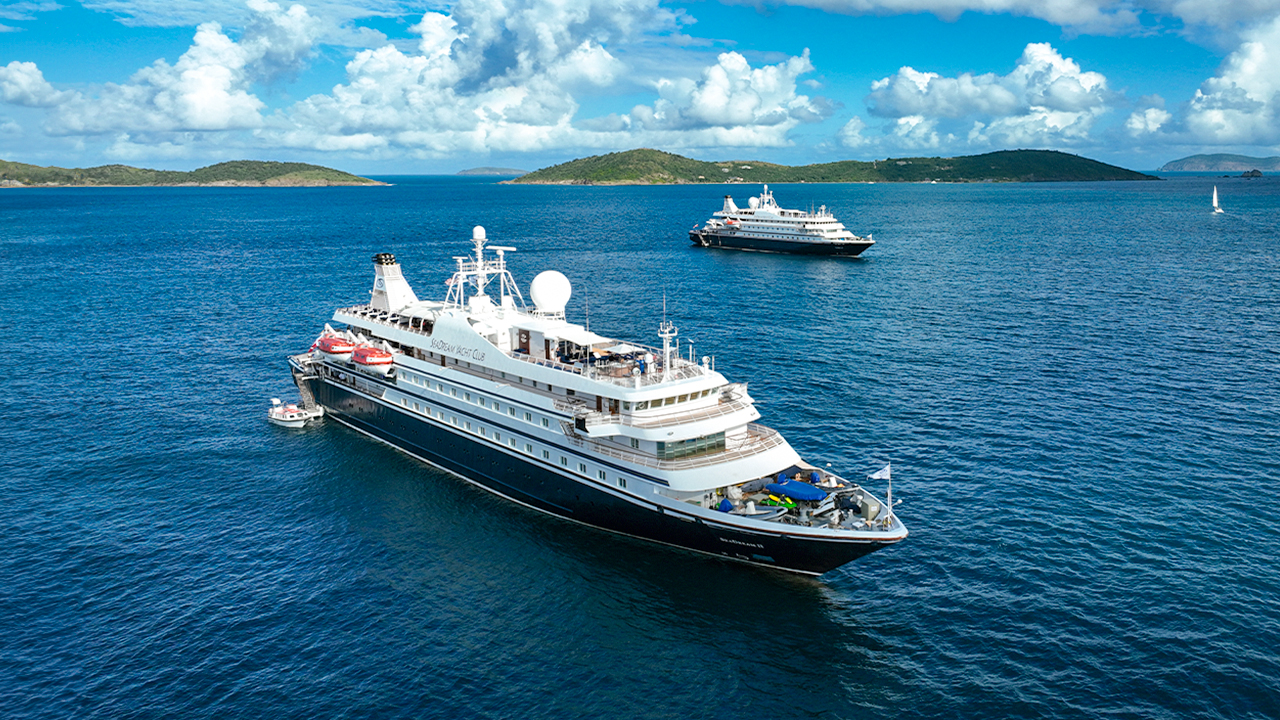
Twenty-seven nights. Two nations. One maiden voyage. SeaDream III sails for the first time through Japan on this inaugural voyage from Hong Kong to Tokyo, anchored by a three-night Christening and Showcase, the ship's official naming ceremony and a rare occasion to be aboard for it. Along the way, an overnight at Ishigaki reveals water so clear it seems lit from below, with Kabira Bay's coral and manta rays just offshore. Yakushima's overnight call opens a UNESCO-listed forest of thousand-year cedars wrapped in moss and cloud, and Amami Oshima, also UNESCO listed, invites a kayak through mangrove tunnels in search of the island's rare black rabbit. The Christening itself takes center stage in Tokyo, three full nights of celebration marking SeaDream III's arrival in Japan. The journey turns toward Korea next, an overnight in Busan bringing Gamcheon's painted hillside and the stalls of Jagalchi fish market. After twenty-seven nights, the voyage concludes in Japan with SeaDream III back in Tokyo, a fitting close to this historic first sailing.
Date
Ports of Call
Arrive
Depart
Jul 10, 2029
Hong Kong, Hong Kong, China
2 PM - 4 PM
(Embarkation)
Evening
Glide into Victoria Harbour as the skyline ignites, SeaDream III overnights here, so the Symphony of Lights becomes your private nightcap from the deck. Ride the century-old Star Ferry at dusk, hunt Michelin-starred dim sum in Central, then take the funicular up Victoria Peak for the whole city laid out at your feet. A dawn sampan through Aberdeen's floating village and a fitting with a bespoke tailor round out a port that rewards those who stay long past sundown.
Manta rays glide through cleaning stations off this Yaeyama Islands hub in numbers rare anywhere else in Japan, drawing serious divers from around the world for a close encounter most only see on film. Kabira Bay's black-pearl farms and impossibly clear, multi-hued water are protected from swimming to preserve the ecozystem, best seen instead from a glass-bottom boat. Egrets and herons crowd the island's mangrove river mouths, while a beach-forward, laid-back pace sets the whole island apart from mainland Japan. Japan's tropics, genuinely.
Manta rays glide through cleaning stations off this Yaeyama Islands hub in numbers rare anywhere else in Japan, drawing serious divers from around the world for a close encounter most only see on film. Kabira Bay's black-pearl farms and impossibly clear, multi-hued water are protected from swimming to preserve the ecozystem, best seen instead from a glass-bottom boat. Egrets and herons crowd the island's mangrove river mouths, while a beach-forward, laid-back pace sets the whole island apart from mainland Japan. Japan's tropics, genuinely.
Shuri Castle, seat of the independent Ryukyu Kingdom for four centuries before Japan absorbed it, reflects a distinct culture, cuisine and even language found nowhere else in the country. Okinawa's population includes some of the highest concentrations of centenarians on earth, a longevity researchers have studied for decades and one that shows up in the local diet of bitter melon, purple sweet potato and slow-cooked pork. Coral reefs ring the main island for some of Japan's best snorkeling, while herons and egrets work the coastal wetlands. Japan, but genuinely, distinctly its own place.
A UNESCO World Heritage subtropical rainforest covers much of this Ryukyu island, home to the Amami rabbit, a primitive, dark-furred species found nowhere else on earth and often called a living fossil. Traditional Oshima tsumugi silk, dyed in mud using a centuries-old technique, is still handwoven here and prized as one of Japan's finest textiles. Mangrove kayaking and some of the clearest coral reef in the Ryukyus round out an island that feels closer to Okinawa's wild heart than to mainland Japan.
Ancient cedar trees, some more than a thousand years old and one estimated at over seven thousand, stand deep in this UNESCO World Heritage rainforest, the same moss-draped landscape that inspired Hayao Miyazaki's Princess Mononoke. Waterfalls tumble through forest so wet it rains, locals joke, thirty-five days a month, while onsen dot the coastline for a soak after the hike. One of the most primeval landscapes anywhere in Japan.
Ancient cedar trees, some more than a thousand years old and one estimated at over seven thousand, stand deep in this UNESCO World Heritage rainforest, the same moss-draped landscape that inspired Hayao Miyazaki's Princess Mononoke. Waterfalls tumble through forest so wet it rains, locals joke, thirty-five days a month, while onsen dot the coastline for a soak after the hike. One of the most primeval landscapes anywhere in Japan.
Shikoku's Sunday market, running for well over a mile through the center of town, is the largest and oldest street market in Japan, farmers and fishermen selling directly from stalls much as they have for over three hundred years. Bonito, seared over a straw fire and sliced thick, is close to a civic dish here, best eaten with a shot of the region's own sake. Ryoma Sakamoto, one of the key figures in ending Japan's feudal era, was born in this city and is honored with a striking bronze statue overlooking the bay. An unpretentious, proudly local corner of Shikoku.
Few views of Mount Fuji rival the one from Miho no Matsubara, a UNESCO-listed pine grove sweeping along the shore here that has been painted and photographed for centuries as the classic frame for the mountain beyond. Shimizu's port lands more tuna than almost anywhere else in Japan, and a proper sushi lunch here is close to essential. A round of golf with Fuji on the horizon and a soak in one of the region's onsen round out one of Japan's most scenically blessed ports.
Few cities anywhere absorb this much contrast this comfortably, centuries-old shrines sit blocks from neon-lit crossings, and a Michelin-starred meal is as easy to find as a standing-room ramen counter. Meiji Shrine's forested grounds, planted from donated trees a century ago, shelter a genuine variety of birdlife within sight of Shibuya's skyscrapers, while Tsukiji Outer Market still trades on the same seafood obsession that built the city's reputation. A round of golf at a classic Kanto course and an evening in Ginza or Shinjuku round out a capital that never quite runs out of new things to show you.
Few cities anywhere absorb this much contrast this comfortably, centuries-old shrines sit blocks from neon-lit crossings, and a Michelin-starred meal is as easy to find as a standing-room ramen counter. Meiji Shrine's forested grounds, planted from donated trees a century ago, shelter a genuine variety of birdlife within sight of Shibuya's skyscrapers, while Tsukiji Outer Market still trades on the same seafood obsession that built the city's reputation. A round of golf at a classic Kanto course and an evening in Ginza or Shinjuku round out a capital that never quite runs out of new things to show you.
Few cities anywhere absorb this much contrast this comfortably, centuries-old shrines sit blocks from neon-lit crossings, and a Michelin-starred meal is as easy to find as a standing-room ramen counter. Meiji Shrine's forested grounds, planted from donated trees a century ago, shelter a genuine variety of birdlife within sight of Shibuya's skyscrapers, while Tsukiji Outer Market still trades on the same seafood obsession that built the city's reputation. A round of golf at a classic Kanto course and an evening in Ginza or Shinjuku round out a capital that never quite runs out of new things to show you.
Few cities anywhere absorb this much contrast this comfortably, centuries-old shrines sit blocks from neon-lit crossings, and a Michelin-starred meal is as easy to find as a standing-room ramen counter. Meiji Shrine's forested grounds, planted from donated trees a century ago, shelter a genuine variety of birdlife within sight of Shibuya's skyscrapers, while Tsukiji Outer Market still trades on the same seafood obsession that built the city's reputation. A round of golf at a classic Kanto course and an evening in Ginza or Shinjuku round out a capital that never quite runs out of new things to show you.
Few cities anywhere absorb this much contrast this comfortably, centuries-old shrines sit blocks from neon-lit crossings, and a Michelin-starred meal is as easy to find as a standing-room ramen counter. Meiji Shrine's forested grounds, planted from donated trees a century ago, shelter a genuine variety of birdlife within sight of Shibuya's skyscrapers, while Tsukiji Outer Market still trades on the same seafood obsession that built the city's reputation. A round of golf at a classic Kanto course and an evening in Ginza or Shinjuku round out a capital that never quite runs out of new things to show you.
Few cities anywhere absorb this much contrast this comfortably, centuries-old shrines sit blocks from neon-lit crossings, and a Michelin-starred meal is as easy to find as a standing-room ramen counter. Meiji Shrine's forested grounds, planted from donated trees a century ago, shelter a genuine variety of birdlife within sight of Shibuya's skyscrapers, while Tsukiji Outer Market still trades on the same seafood obsession that built the city's reputation. A round of golf at a classic Kanto course and an evening in Ginza or Shinjuku round out a capital that never quite runs out of new things to show you.
The night view from Mount Hakodate is regularly ranked among the three best in the world, the city's hourglass-shaped peninsula lit up between two bays in a way no photograph quite captures. The morning market sells uni and crab straight off the boat before dawn, while the star-shaped Goryokaku fortress recalls the last stand of Japan's old shogunate forces in 1869. A Trappist convent on the outskirts has made wine and dairy here since the 19th century, and a round of golf in the cool northern air rounds out one of Hokkaido's most rewarding cities.
The Nebuta Matsuri's illuminated paper floats, vast warrior figures lit from within, are the highlight of one of Japan's most spectacular summer festivals, and a dedicated museum keeps the tradition alive year-round for visitors who miss the August dates. Aomori grows more apples than anywhere else in Japan, and a cidery tasting is close to compulsory. Hot spring onsen culture runs deep across the surrounding Tohoku countryside, and clean, quiet beaches line the bay just beyond the city. A proper taste of rural, traditional Japan.
Rice paddies and sake breweries define this quiet northern prefecture, its Namahage folklore, fearsome straw-clad demons who visit homes each New Year's Eve to scold lazy children, is unique to the Oga Peninsula and unlike anything else in Japan. Kakunodate's samurai district, lined with black-walled residences and weeping cherry trees, is one of Tohoku's best-preserved historic quarters. A properly restorative onsen soak after a day exploring rounds out a genuinely traditional corner of rural Japan.
Kenrokuen, one of Japan's three great gardens, was designed over two centuries to look perfect in every season, and largely still does. The Higashi Chaya geisha district's lattice-fronted teahouses remain in genuine use, not merely preserved for tourists, while the city's gold-leaf craft, producing nearly all of Japan's supply, turns up on everything from ice cream to sake cups. Omicho Market's seafood stalls, fed by the Sea of Japan, are among the best in the country. Edo-era Japan, remarkably intact.
This small fishing port turned its most famous native son into a genuine tourist industry, a mile-long shopping street lined with more than a hundred bronze statues of yokai spirits from manga artist Shigeru Mizuki's work, best known abroad as GeGeGe no Kitaro. The port itself lands some of the best crab and seafood on the Sea of Japan coast, sold fresh at the harbor market each morning. A quirky, characterful stop unlike anywhere else in Japan.
South Korea's second city wraps around Haeundae Beach's high-rise skyline on one side and the pastel, cliffside houses of Gamcheon Culture Village on the other, a former slum reinvented as an open-air art installation. Jagalchi Fish Market, the country's largest, sells the day's catch straight off the boats each morning, while a serious spa and jjimjilbang bathhouse culture offers a properly restorative afternoon between meals. A round of golf and some of Korea's best beaches round out a genuinely dynamic port city.
South Korea's second city wraps around Haeundae Beach's high-rise skyline on one side and the pastel, cliffside houses of Gamcheon Culture Village on the other, a former slum reinvented as an open-air art installation. Jagalchi Fish Market, the country's largest, sells the day's catch straight off the boats each morning, while a serious spa and jjimjilbang bathhouse culture offers a properly restorative afternoon between meals. A round of golf and some of Korea's best beaches round out a genuinely dynamic port city.
Fukuoka's old merchant quarter still runs on the yatai food stalls that line its rivers each evening, plastic-sheet tents serving the tonkotsu pork-bone ramen this city is credited with inventing. Canal City's shopping and entertainment complex shows the region's more modern face, while Dazaifu's shrine and gardens, a short train ride out, offer a quieter, more contemplative counterpoint. A strong onsen and wellness culture in the surrounding hills, and clean beaches along Hakata Bay, round out one of Kyushu's most food-obsessed cities.
The Peace Memorial Park and its skeletal Atomic Bomb Dome confront the city's 1945 history directly and without flinching, one of the most moving sites in Japan and a genuine pilgrimage regardless of nationality. A short ferry ride away, Miyajima's floating torii gate at Itsukushima Shrine appears to hover on the tide, one of Japan's most photographed views, while the city's own okonomiyaki, layered rather than mixed, has passionate defenders against Osaka's version. A dining scene, a wellness culture and a genuinely uplifting sense of renewal round out a city defined by resilience.
Japan's most celebrated beef takes its name from this handsome port city, and a proper teppanyaki dinner here remains one of the country's great culinary rites of passage. Arima Onsen, one of Japan's oldest hot spring resorts, lies a short cable-car ride up Mount Rokko, while a small but historic winery tradition, among Japan's earliest, still operates in the surrounding hills. A round of golf, a walk through the Nunobiki herb gardens, and beaches along the bay round out one of Japan's most cosmopolitan port cities.
Kokichi Mikimoto perfected the cultured pearl on the small island in this bay that now bears his name, and Mikimoto Pearl Island still stages daily demonstrations by the ama, traditional female free-divers who have harvested these waters for centuries. Ise Grand Shrine, the most sacred site in Shinto and rebuilt in an identical form every twenty years for over a millennium, lies a short drive away. A properly restorative onsen soak and fresh Ise-ebi lobster round out one of Japan's most historically resonant coastal regions.
The view of Mount Fuji from this small port made Hokusai's woodblock prints famous well beyond Japan, and it remains one of the classic vantage points on the mountain today, framed by the same pine-lined shore. Tagonoura shirasu, tiny whitebait landed fresh each morning, is the local delicacy worth seeking out. A round of golf, an onsen soak and Fuji looming over every one of them round out a small port built entirely around one extraordinary view.
Few cities anywhere absorb this much contrast this comfortably, centuries-old shrines sit blocks from neon-lit crossings, and a Michelin-starred meal is as easy to find as a standing-room ramen counter. Meiji Shrine's forested grounds, planted from donated trees a century ago, shelter a genuine variety of birdlife within sight of Shibuya's skyscrapers, while Tsukiji Outer Market still trades on the same seafood obsession that built the city's reputation. A round of golf at a classic Kanto course and an evening in Ginza or Shinjuku round out a capital that never quite runs out of new things to show you.
More details about the suites and staterooms aboard SeaDream III
will be announced soon. In the meantime, our reservations team would be happy to
help you reserve your voyage.